


Page 2 - BOOK-4-TOTS_v2
P. 2
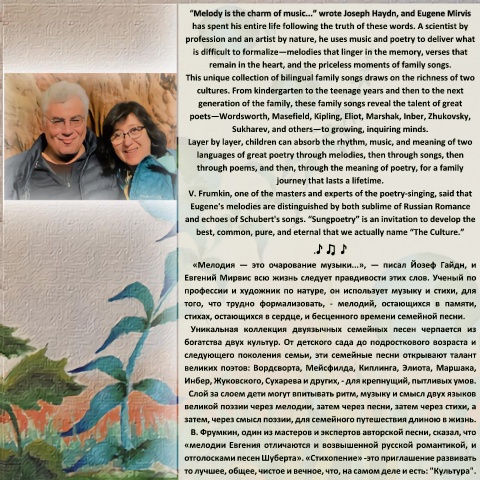
“Melody is the charm of music...” wrote Joseph Haydn, and Eugene Mirvis
                                               has spent his entire life following the truth of these words. A scientist by
                                              profession and an artist by nature, he uses music and poetry to deliver what
                                               is difficult to formalize—melodies that linger in the memory, verses that
                                                   remain in the heart, and the priceless moments of family songs.
                                              This unique collection of bilingual family songs draws on the richness of two
                                                cultures. From kindergarten to the teenage years and then to the next
                                                 generation of the family, these family songs reveal the talent of great
                                               poets—Wordsworth, Masefield, Kipling, Eliot, Marshak, Inber, Zhukovsky,
                                                         Sukharev, and others—to growing, inquiring minds.
                                              Layer by layer, children can absorb the rhythm, music, and meaning of two
                                                languages of great poetry through melodies, then through songs, then
                                                through poems, and then, through the meaning of poetry, for a family
                                                                   journey that lasts a lifetime.
                                              V. Frumkin, one of the masters and experts of the poetry-singing, said that
                                               Eugene's melodies are distinguished by both sublime of Russian Romance
                                             and echoes of Schubert's songs. “Sungpoetry” is an invitation to develop the
                                                best, common, pure, and eternal that we actually name “The Culture.”

                                                                            .♪ ♫ ♪
                                                 «Мелодия  —  это  очарование  музыки...»,  —  писал  Йозеф  Гайдн,  и
                                             Евгений Мирвис всю жизнь следует правдивости этих слов. Ученый по
                                             профессии  и  художник по  натуре,  он  использует  музыку  и  стихи,  для
                                             того,  что  трудно  формализовать,  -  мелодий,  остающихся  в  памяти,
                                             стихах, остающихся в сердце, и бесценного времени семейной песни.
                                                Уникальная  коллекция  двуязычных  семейных  песен  черпается  из
                                             богатства двух культур. От детского сада до подросткового возраста и
                                             следующего  поколения  семьи,  эти  семейные  песни  открывают талант
                                             великих поэтов: Вордсворта, Мейсфилда, Киплинга, Элиота, Маршака,
                                             Инбер, Жуковского, Сухарева и других, - для крепнущий, пытливых умов.
                                               Слой за слоем дети могут впитывать ритм, музыку и смысл двух языков
                                             великой поэзии через мелодии, затем через песни, затем через стихи, а
                                             затем, через смысл поэзии, для семейного путешествия длиною в жизнь.
                                                В. Фрумкин, один из мастеров и экспертов авторской песни, сказал, что
                                             «мелодии Евгения отличаются  и возвышенной русской романтикой,  и
                                             отголосками песен Шуберта». «Стихопение» -это приглашение развивать
                                             то лучшее, общее, чистое и вечное, что, на самом деле и есть: "Культура".

